Digital Systems
What exactly is a computer?
Before diving into the world of programming, it's worth reflecting on how these machines work. They're powered with electricity and they can only understand binary code (0s and 1s), but how does this magic happen? A computer is an electronic device made up of digital circuits, but that doesn't mean everything digital, like a simple calculator, is a computer, does it? A simple calculator, for example, isn't a computer because it's not programmable — this is where you as a programmer join the picture! We develop code to run on it! But... how does electricity represent information? how do 0s and 1s go beyond numbers? how do these elements enable the complex operations we see in computers today?
Electric Signals
We're sure you've heard about digital and analog signals... Can you guess what type of signals are used in computers? Digital signals can only have two states: on (1) or off (0). Analog signals, on the other hand, are continuous and can take any value (like sound waves)! One of the key benefits of digital communication is it's resistance to noise interference. While noise can significantly disrupt analog signals, digital signals remain relatively unaffected, as it is easy to distinguish between a 0 and a 1, even in the presence of considerable noise making them perfect for computers to process data accurately!
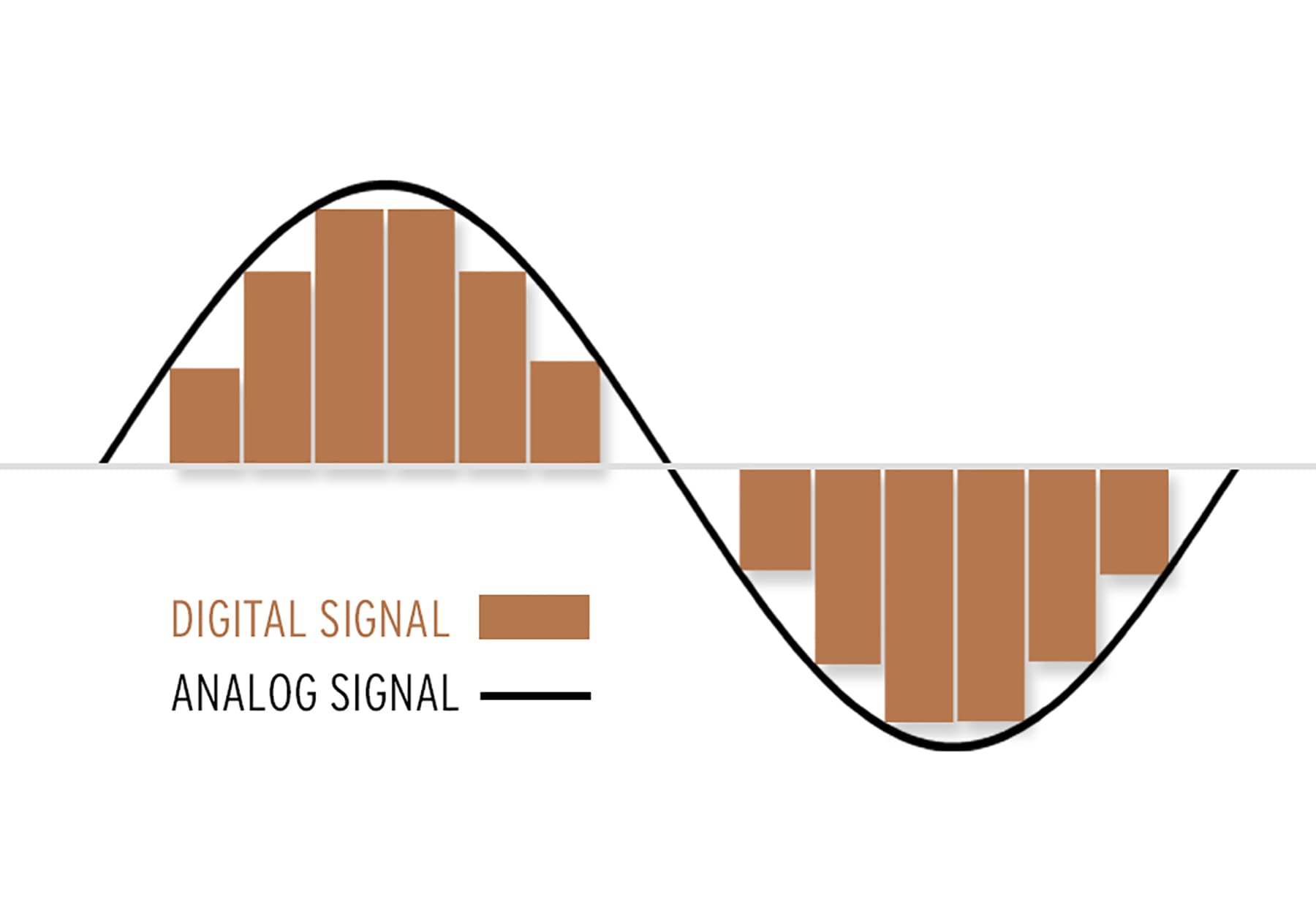
digital & analog signals
Number systems
Why do computers use sequences of 0s and 1s to store and process information, and how do they do it? Computers process information using digital electrical signals, which have two distinct states: 0 and 1. These binary states align with the binary system, a base-2 numeral system, where all values are represented using only these two digits. In contrast, the numeral system most of us are familiar with is the Hindu-Arabic system which is base-10, meaning it uses ten digits (0-9) to represent values. This system is natural for humans because we have ten fingers, making counting in tens intuitive. The reason computers use the binary system is that digital circuits are designed to easily distinguish between two states, such as "on" and "off," or "true" and "false." Each 0 or 1 in binary is known as a bit, the smallest unit of data in computing. By combining groups of bits, larger values can be represented. Just like the decimal system, binary follows the same basic principles, where the position of each digit corresponds to a power of 2. It might sound a bit basic, but it's the backbone of everything computers do. Bits are the building blocks of binary code, allowing computers to store and process information. It's pretty surprising how these two simple values, 0 and 1, can represent all kinds of complex things like images, music, and videos! Although computers use binary for processing, hexadecimal (base-16) is often used by humans as a shorthand to represent binary data in a more compact and readable way. Hexadecimal makes it easier for programmers and engineers to work with large binary values because one hexadecimal digit corresponds to four binary digits, simplifying the representation of long binary numbers.
| Decimal (Base 10) | Binary (Base 2) | Hexadecimal (Base 16) |
|---|---|---|
| 0 | 0000 | 0 |
| 1 | 0001 | 1 |
| 2 | 0010 | 2 |
| 3 | 0011 | 3 |
| 4 | 0100 | 4 |
| 5 | 0101 | 5 |
| 6 | 0110 | 6 |
| 7 | 0111 | 7 |
| 8 | 1000 | 8 |
| 9 | 1001 | 9 |
| 10 | 1010 | A |
| 11 | 1011 | B |
| 12 | 1100 | C |
| 13 | 1101 | D |
| 14 | 1110 | E |
| 15 | 1111 | F |
Binary and Voltage
Electricity is the medium that powers all digital systems, but how do we use it to represent data? In digital electronics, we define two voltage levels to represent binary values:
- x>A high voltage represents a binary 1.
- x>A low or zero voltage represents a binary 0.
This system relies on setting a clear threshold. For example, anything above 3 volts might be read as a 1, and anything below 1 volt as a 0. This makes binary data very reliable, even when there's noise or slight fluctuation in the voltage. By using this method, we can send sequences of 1s and 0s (digital signals) over wires to transmit information.
Boolean Logic
Binary numbers are only part of the story. To actually process information, computers rely on a type of algebra called Boolean logic. Boolean logic uses only two values: true (1) and false (0). It includes basic operations:
- x>AND: True if both inputs are true
- x>OR: True if at least one input is true
- x>NOT: Reverses the input (true becomes false, and vice versa)
These logical rules form the basis for how computers make decisions and perform calculations using binary data.
Logic Gates
Logic gates are physical components that apply Boolean logic to binary inputs. Each gate takes in one or more binary inputs and produces a binary output based on a logical operation. Common gates include:
- x>AND Gate: Output is 1 only if both inputs are 1
- x>OR Gate: Output is 1 if at least one input is 1
- x>NOT Gate: Outputs the opposite of the input
These gates are built from electrical components like transistors and are the building blocks of all digital circuits.
Combining Logic Gates
By combining logic gates, we can build more complex digital circuits that perform useful tasks. For example:
- x>A 1-bit adder can take two binary digits and output their sum.
- x>A comparator can check if two binary values are equal.
These basic circuits are used to build more advanced systems like calculators, memory units, and processors. Everything a computer does starts from combinations of these small, simple logic gates.
Transistors: The Physical Layer
At the heart of every logic gate is a component called a transistor. A transistor acts like a switch controlled by electrical signals:
- x>When it's "on," it allows current to flow (representing a 1).
- x>When it's "off," it blocks current (representing a 0).
Logic gates are made by wiring together multiple transistors. Millions (or billions) of transistors are packed into a single chip (like a CPU) to create powerful digital systems. Transistors are the foundation of all modern digital electronics.
Why Binary + Logic = Computers
So, why does all this matter? Because with binary and logic gates, you can represent and manipulate information using electricity.
- x>Binary gives us a simple, reliable way to represent data with just two voltage levels.
- x>Boolean logic and gates allow us to make decisions and perform operations on that data.
- x>Transistors make these gates possible at the physical level.
By combining all of this, we can build circuits that store, process, and transmit information — exactly what a computer does. Understanding this gives you a solid foundation for what lies beneath any modern programming language or web application. You now know what it really means when we say a computer "understands" 0s and 1s.
Conclusion
So, a computer is a machine made of digital circuits that manipulate binary information using electricity. The journey to building such a machine required knowledge from different fields — mathematics, logic, and electronics — coming together. The discovery that electrical circuits could implement Boolean logic was revolutionary. It meant we could manipulate information, not just move it. By assigning binary values to voltage levels, digital systems became both reliable and scalable. Transistors allowed for the creation of compact and powerful circuits, and logic gates abstracted those into decision-making tools. With just 0s and 1s, controlled by electricity and organized using logic, we can build machines that perform millions of operations per second. These foundations are what make modern computing — and eventually, programming and web development — possible. Now that you understand how computers process and represent data at the most fundamental level, you're ready to explore how we use code to control them and build interactive experiences like websites.