Beyond the Basics of OOP – Abstract Classes, Interfaces, and the Object Class
You’ve already got a good grip on classes, objects, fields, and methods. You’ve even worked with enums and collections. But Java isn’t just about objects — it’s about powerful abstractions that help us build scalable, modular, and flexible code. Let’s unlock that next level.
Why More Abstraction?
Let’s say you’re designing a system for different kinds of vehicles. All vehicles move, but how they move differs — planes fly, cars drive, boats sail. You need a blueprint that says: "All vehicles must be able to move." But it shouldn’t define how. That’s where abstract classes and interfaces come in.
Abstract Classes – Half-Built Blueprints
An abstract class lets you define some behavior while leaving the rest to be filled in by subclasses.
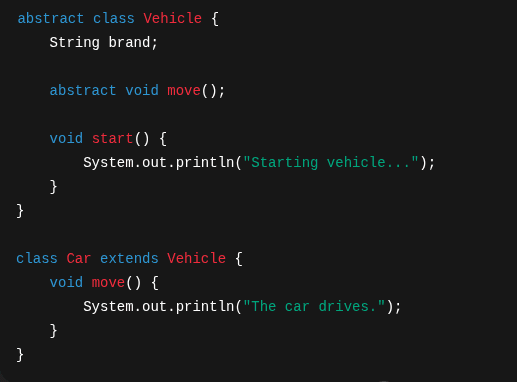
- x>You can’t create an object of an abstract class.
- x>You can define concrete methods and fields.
- x>You must override abstract methods in subclasses.
Use an abstract class when you want to:
- x>Share some implementation
- x>Force subclasses to implement certain methods
Interfaces – Contracts for Behavior
An interface is like a contract. It says: "If you implement me, you promise to provide these methods."
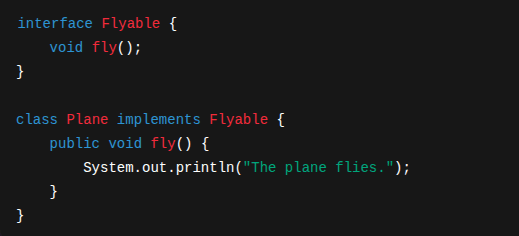
- x>Interfaces can’t have fields (except constants).
- x>All methods are implicitly public and abstract (unless default or static).
- x>A class can implement multiple interfaces — great for flexibility.
Use interfaces when you want to:
- x>Define capabilities (Flyable, Readable, Drivable)
- x>Separate concerns and promote loose coupling
Abstract vs Interface – When to Use What
| Use Abstract Class When | Use Interface When |
|---|---|
| Sharing code (fields/methods) | Just defining method contracts |
| You want to provide base logic | You need multiple inheritance |
| You expect subclasses to be tightly related | You’re modeling capabilities |
In modern Java, interfaces can also have default methods, which allow shared behavior — blurring the lines a bit. But the distinction still matters.
The Object Class – Everyone’s Grandparent
In Java, everything inherits from Object, even if you don’t say it explicitly. That means every class has:
- x>toString() – What shows up when you System.out.println(obj)
- x>equals() – For comparing objects
- x>hashCode() – Used in hashing structures like HashMap
You can (and often should) override them:

Understanding Object helps when working with collections, debugging, and designing clean APIs.
Recap
- x>Abstract classes = partial implementation + enforced methods
- x>Interfaces = pure contracts for behavior, can be combined
- x>Object class = universal base, provides essential methods
You now have the tools to build better abstractions and more adaptable code.
What’s Next
You’re now equipped to work with complex systems. Let’s shift gears and talk about how developers solve problems, debug, and break work down into manageable logic: Up next: “Thinking Like a Developer” – your mindset guide to real-world programming.