Java Collections: Organizing Data Like a Pro
You’ve seen how to work with variables, arrays, and algorithms — but real-world problems rarely involve just a handful of numbers or strings. More often, you’re dealing with lists of users, products, or messages. That’s where collections come in. Java Collections are like containers that grow and adapt — helping you store, manage, and access your data more efficiently and flexibly.
What Are Collections?
A collection is an object that groups multiple elements into a single unit. You can think of it as a toolbox full of different compartments — each one optimized for a different kind of job. Java gives us an entire Collections Framework to choose from — a set of ready-to-use classes and interfaces that make data handling easier.
Meet the Main Types
Let’s get a quick overview of the most commonly used collection types:
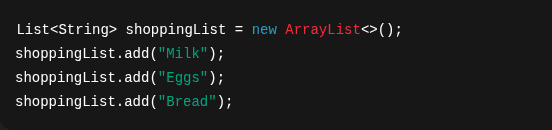
List
- x>Maintains order
- x>Allows duplicates
- x>Think: A playlist of songs
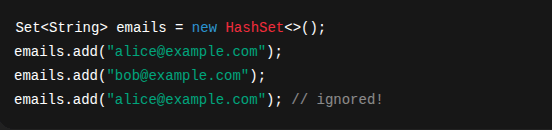
Set
- x>No duplicates
- x>Doesn’t guarantee order
- x>Think: A collection of unique email addresses
Map
- x>Stores key-value pairs
- x>Think: A dictionary or phone book

Choosing the Right Tool
| Goal | Use This |
|---|---|
| You need a list in order | ArrayList |
| You need fast lookups | HashMap |
| You need unique items only | HashSet |
| You need sorted elements | TreeSet, TreeMap |
| You frequently insert/remove from ends | LinkedList |
Loops + Collections = Power
You can loop through collections using for-each loops — a clean and easy way to process all elements.

You can also use .contains(), .remove(), .size(), and more — collections are packed with helpful methods.
Behind the Scenes
You don’t need to memorize everything, but it helps to understand:
- x>ArrayList is backed by an array — fast for access, slower for insert/remove in the middle.
- x>HashSet and HashMap use hashing — fast for checking if something exists.
- x>TreeSet and TreeMap keep things sorted.
The more you learn, the better you’ll be at picking the right structure for the job.
Practice Challenge: Favorite Colors
Ask the user to enter their top 3 favorite colors.Store them in a List.Then, print them one by one in reverse order.Bonus:
Try storing the colors in a Set. What changes?Can you map favorite colors to reasons using a Map?Conclusion: Organizing for Impact
Collections are everywhere — in every app, every backend system, every feature that involves lists, searches, or groupings. They’re your go-to structures for data-driven thinking. Get comfortable here — you’ll be using them every day.
What’s Next
Now that you’re thinking in terms of lists, sets, and mappings — it’s time to take another step in designing clean, powerful software. In the next chapter, you’ll learn about abstraction, interfaces, and polymorphism — the next level of object-oriented power. You’ll design flexible code that’s easier to reuse and expand. Let’s elevate your architecture.